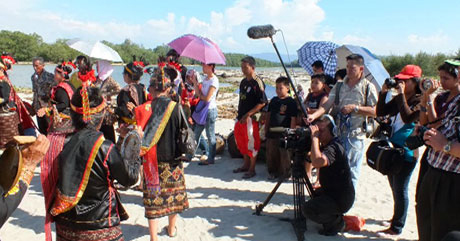
Understanding Sabah’s 49 Ethnic Groups:
Unity in Diversity
Who Are the 49 Ethnic Groups?
Sabah’s official count of ethnic groups encompasses a spectrum of major and minor communities. While census figures and scholarly estimates sometimes vary, the general understanding today includes the following notable groups:
| Major Indigenous Groups | Coastal and Lowland Groups | Minor/ Sub-Groups and New Communities |
| Kadazan-Dusun (+ 40 subgroups) | Bajau (West Coast & “Sea Bajau”) | Ida’an, Bonggi, Minokok, Tidong, etc. |
| Murut (+ 29 subgroups) | Brunei Malay, Bugis, Illanun, Kedayan | Orang Cocos, Lundayeh, others |
| Rungus | Suluk, Orang Sungai | Chinese (main non-indigenous group) |
| Paitan (collective of several small groups) |
The cultural expressions, dialects, and histories are distinct, yet closely woven together via shared festivals (like the Kaamatan), oral histories (Nunuk Ragang origin myth), and interrelated kinship ties.
Key Demographic Facts
- As of the 2020 Malaysian census, Sabah’s population stands at 3.4 million, with indigenous peoples forming the majority-despite growing numbers of migrants and non-citizen residents.
- At least 50 languages and 80 ethnic dialects are actively spoken, with some at critical risk of extinction. The Kadazan-Dusun population makes up nearly 30%, making it the state’s largest group, with significant minorities among Bajau, Murut, Rungus, and Paitan peoples.
Wider Significance: Sabah’s unique diversity is a point of pride and an invaluable heritage for Malaysia and the world at large. Momogun College is designed as the educational “home” for all these groups-unifying rather than homogenizing, and providing platforms where differences are celebrated as foundational strengths.
Supporting Language and Culture via Digital Platforms: Key Strategies
Leveraging Technology for Heritage Preservation
Research demonstrates that ICT-when made accessible, affordable, and integrated with local values-can powerfully support preservation and revitalization of indigenous cultures. However, effective adoption depends on social support, training, affordable access, and sensitivity to community needs.
Momogun College employs the following technology-driven strategies:
- Language Digitization and Courseware: Building digital dictionaries, online language courses, and content archives for endangered languages using user-friendly formats and AI-assisted transcription, training local contributors as digital archivists.
- Storytelling and Oral History Projects: Enabling community members (including elders with minimal digital skills) to record and upload oral traditions, songs, and ceremonies in local dialects, thus ensuring accessibility for future generations as recommended by UNESCO and leading educational researchers.
- Virtual Heritage Festivals and Collaboration Hubs: Hosting online events, forums, and peer-to-peer mentoring for cultural documentation, creating a living museum of Sabah’s intangibles accessible from anywhere in the world.
- Mobile Learning and Offline Compatibility: Recognizing patchy connectivity in rural Sabah, all resources are optimized for low data use, downloadable for offline study, and distributed on tablets and mobile devices as part of state pilot initiatives.
- Blended Learning with Community Anchors: Combining online coursework with local facilitators and learning circles, ensuring that social influence-the strongest determinant of ICT adoption-is used to promote technological engagement for cultural heritage purposes.
The integration of these strategies draws from global best practices in indigenous-serving online colleges, such as Northern New Mexico College’s dual-credit programs with local pueblos and Australian MOOC case studies centering native pedagogies.
Heritage-Rooted Academic Excellence: Pedagogical and Program Design
Curriculum and Excellence Model
Momogun College’s academic framework merges international standards with local content:
- Core curriculum includes not just standard academic subjects, but also indigenous knowledge courses (e.g., ethnobotany, traditional governance, oral literature, digital storytelling).
- Holistic assessment measures both competency in global skills and proficiency in cultural leadership, language use, and creative contribution to community well-being.
- Student-led community projects (e.g., digital conservation, youth entrepreneurship) serve as capstone experiences, embodying the college’s commitment to “learning by doing” in service of local goals.
This model is informed by the success of schools which blend arts, experiential learning, and local values with academic rigor, ensuring graduates are not just literate and technologically competent, but deeply connected to community and identity.
Empowering Community for Socioeconomic Progress
Momogun College places economic empowerment alongside academic and cultural goals, in line with Momogun National Congress’s vision for broad-based community advancement. By teaching skills such as:
- E-commerce and digital business for rural entrepreneurs
- Agricultural technology tailored to indigenous knowledge and local ecology
- Leadership, negotiation, and advocacy for land and resource rights
…the College equips its graduates to be active shapers, not passive recipients, of Sabah’s development future.
Alignment with Sabah Government Digital Education Policy and State Priorities
Sabah’s government and leading policymakers have made education and digital inclusion the centerpiece of poverty eradication and socioeconomic transformation strategies. The Sabah Maju Jaya (SMJ) Roadmap explicitly calls for inclusive, smart education as a driver of human capital and technological adoption.
Momogun College’s model is fully aligned with this agenda, offering:
- Systematic support for marginalized and rural learners (B40 households, undocumented children, rural youth) through digital sponsorships, scholarships, and blended learning pilots funded by state and federal grants.
- Collaboration with government-linked companies, public agencies, and advocacy groups to improve connectivity, infrastructure, and access.
- Responsive, data-driven refinement: Constant monitoring of impact and needs, ensuring curricular and technological updates in partnership with the Sabah Education Department and policy researchers.
This symbiotic relationship accelerates the closing of educational and digital divides, ensuring Momogun College serves as a flagship in achieving state, national, and international inclusion benchmarks.